
DCS/DEC stands for Diploma of College Studies (in English) or Diplôme d’études collégiales (in French). It’s a two- or three-year credential unique to Quebec’s public college system, known as CEGEP, and it’s required for university admission in the province. If you’re an international student or newcomer planning to study in Canada, understanding the DCS/DEC is essential because Quebec follows a different education pathway than the rest of the country.
Unlike other Canadian provinces where students move directly from Grade 12 to university, Quebec high school ends after Grade 11 (Secondary V). Students then complete a two-year pre-university DCS/DEC or a three-year technical DCS/DEC at CEGEP before entering university or the workforce. This structure means your pathway to a bachelor’s degree in Quebec involves an extra step, but it also opens doors to hands-on career training and flexible study options, including programs offered online through institutions like Cégep à distance, which follows the same admission standards as traditional CEGEPs.
Whether you’re weighing study options across Canada or trying to decode Quebec credential requirements, this guide breaks down what the DCS/DEC is, how it works, the two program types available, and how it fits into your academic and career plans as an international student.
What DCS/DEC Stands For
DCS and DEC are two acronyms for the same Quebec college credential. DCS stands for Diploma of College Studies in English, while DEC is the French acronym for Diplôme d’études collégiales. If you’re researching education in Canada and encounter either term, you’re looking at the same qualification.
Quebec’s government explains that CEGEPs, Collèges d’enseignement général et professionnel, are unique to the province and serve as a bridge between secondary school and university or the workforce. After finishing high school (Secondary V in Quebec), students enter a CEGEP program to earn their DCS/DEC. This step doesn’t exist in other Canadian provinces, where students typically move directly from high school to university or college.
- DCS (Diploma of College Studies)
- The English name for Quebec’s post-secondary college diploma, awarded after completing a CEGEP program.
- DEC (Diplôme d’études collégiales)
- The French name for the same Quebec college diploma; DCS/DEC are the same credential with different language labels.
- CEGEP
- A Quebec-specific educational institution (Collège d’enseignement général et professionnel) that offers DCS/DEC programs bridging high school and university or career entry.
Both acronyms appear on official documents, program listings, and admission pages across Quebec’s college system. Whether you see DCS or DEC depends on the language of the source, but the credential itself carries the same weight and opens the same doors. Understanding this dual naming helps newcomers and international students navigate Quebec’s education landscape without confusion.
How the DCS/DEC Program Works
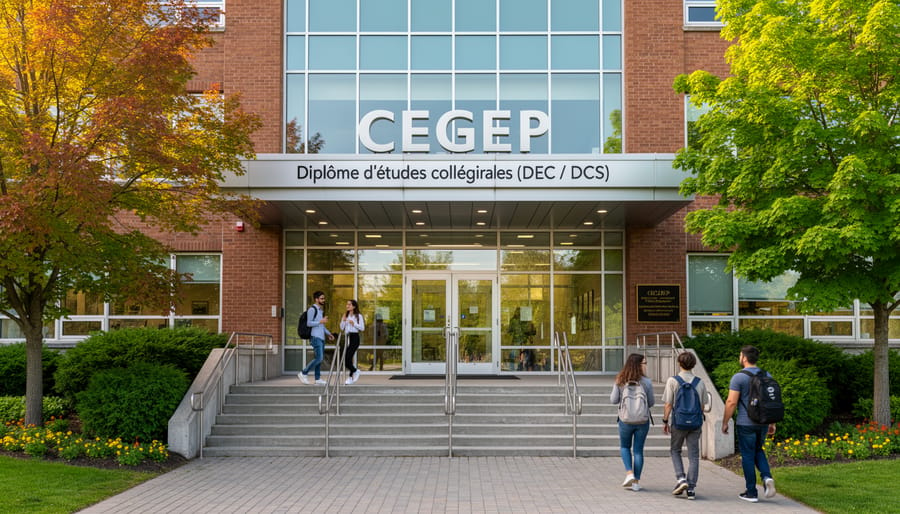
Admission Requirements for a DCS/DEC
To get into a DCS/DEC program, you must meet one of four standard admission requirements set out in Quebec’s Règlement sur le régime des études collégiales. Individual CEGEPs apply these rules when reviewing applications.
The most common path is completing Secondary V in Quebec (or an equivalent credential from another province or country). If you finished high school outside Quebec, the CEGEP will assess whether your diploma meets the standard. Most CEGEPs require that you have passed specific courses, such as Secondary V Math and Language Arts, depending on the program you choose.
Beyond the basic diploma, each DCS/DEC program can set its own prerequisites. Pre-university programs in Sciences, for example, typically require advanced math and science courses from high school. Technical programs in Nursing or Computer Science may ask for different subject backgrounds. Check the program page at the CEGEP you are applying to for the exact list.
Cégep à distance follows the same admission requirements as traditional CEGEPs. Whether you study on campus or online, the provincial standards and the Cégep à distance admission policy both apply. That means your application will be reviewed under the same rules, and you will need to meet the same prerequisites as students attending in person.
Types of DCS/DEC Programs
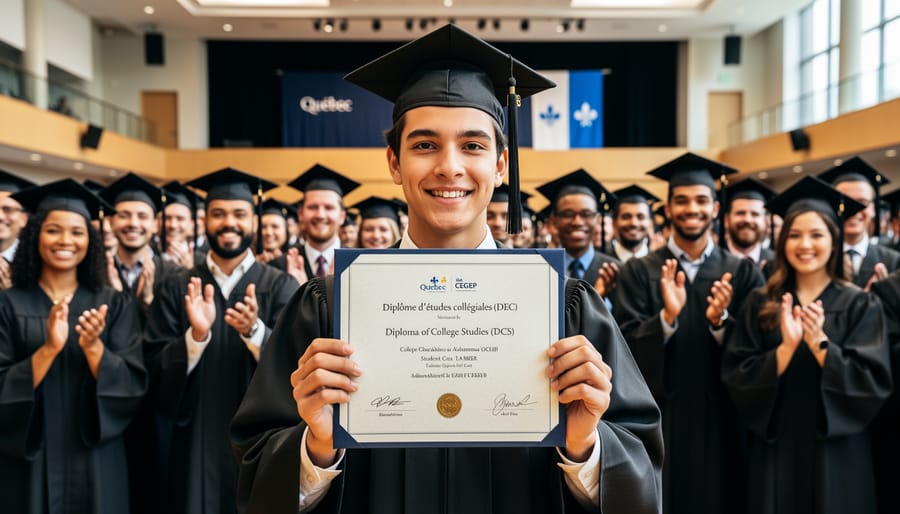
When you apply for a DCS/DEC, you’ll choose between two distinct program categories. Both award the same diploma credential, but they’re designed for different career and study goals.
Pre-university programs run two years full-time and prepare you for admission to a Quebec university. You’ll complete a mix of general education courses (French, English, philosophy, physical education) and program-specific courses in your chosen field. These programs don’t lead directly to a profession; instead, they build the academic foundation you need for a bachelor’s degree. Common pre-university families include:
- Sciences, biology, chemistry, physics, mathematics for students planning health sciences, engineering, or pure sciences
- Social Sciences, psychology, sociology, economics, political science for those aiming toward law, education, or social work
- Arts, literature, visual arts, music, theatre for creative and humanities degree paths
Technical programs span three years and combine practical skills training with theoretical coursework. These prepare you to enter the workforce immediately after graduation, though many graduates also continue to university if they choose. You’ll graduate with hands-on competencies in a specific trade or profession. Popular technical families include:
- Health Sciences, nursing, respiratory therapy, medical imaging for direct entry to healthcare roles
- Computer Science, programming, network administration, cybersecurity for IT careers
- Business, accounting, marketing, human resources for office and management positions
- Engineering Technology, civil, mechanical, electrical for technician and technologist roles
Both pathways lead to the same DCS/DEC credential, so your choice depends on whether you want to continue to university right away or start working (with the option to study later). Many international students choose technical programs for the work permit and permanent residency pathways they can unlock after graduation.
Where and How You Can Earn a DCS/DEC
You can earn a DCS/DEC at any of Quebec’s CEGEPs, which are spread across the province from Montreal and Quebec City to smaller regional centres. Most CEGEPs offer in-person programs on campus, but Quebec also provides flexible distance-learning options through Cégep à distance, a fully accredited member of the provincial college system subject to the same laws and obligations as traditional CEGEPs.
Cégep à distance is particularly useful if you need to complete specific courses rather than enrol in a full program. You can take general education courses (like French, English, or Humanities) and mandatory complementary courses required for any DCS/DEC, even if the complete program you’re pursuing isn’t available online. That flexibility lets you fill gaps, upgrade prerequisites, or finish remaining credits while balancing work, family, or other commitments. Admission requirements at Cégep à distance are identical to those at other CEGEPs, and applications are reviewed under the same provincial regulation (Règlement sur le régime des études collégiales) and the Cégep’s own admission policy.
For students comparing pathways, understanding your online school options across Canada can clarify how Quebec’s distance CEGEP model differs from K, 12 virtual schools or university online programs. Whether you attend in person or online, the DCS/DEC you earn carries the same provincial recognition and opens the same doors to university or career entry.
What Is a Springboard to a DCS (DEC)?
The Springboard to a DCS/DEC, known in French as Tremplin DEC, is a preparatory pathway designed for students who don’t yet meet the admission requirements for a regular college program. Think of it as a bridge: it gives you time to complete missing prerequisites, strengthen academic skills, or confirm which field you want to pursue before committing to a full DCS/DEC program.
This option is especially valuable for international students adjusting to Quebec’s education system or mature learners returning to school after a gap. If your secondary school credentials don’t align with Quebec’s Secondary V requirements, or if you need to upgrade specific courses like math or science to qualify for a competitive program, the Springboard pathway lets you do that within the CEGEP framework.
During a Tremplin DEC semester, you’ll take general education courses and program prerequisites while exploring different fields. It’s structured and supported, so you’re not navigating the system alone. Once you complete the required courses and meet the admission criteria, you can transition into a full DCS/DEC program, whether pre-university or technical.
This pathway is offered at most CEGEPs across Quebec. If you’re an international student unsure where you stand academically or which program fits your goals, the Springboard to a DCS/DEC offers a practical, low-risk entry point to Canadian college education.
DCS/DEC for International Students: What You Need to Know
If you’re an international student planning to pursue a DCS/DEC, you’ll need a valid study permit to enroll in a CEGEP program. Start by confirming that your secondary school credentials are equivalent to Quebec Secondary V, most CEGEPs and the provincial SRAM application portal will assess your transcripts during the admissions process. You’ll also need to demonstrate French or English proficiency, depending on the language of instruction at your chosen CEGEP.
Research CEGEP programs early. Decide whether a pre-university or technical stream aligns with your goals, then review program prerequisites and application deadlines on each college’s website. Most CEGEPs use the SRAM (Service régional d’admission du Montréal métropolitain) portal for applications, though some accept direct applications. International applicants typically apply in the fall for programs starting the following September, so plan at least six to nine months ahead to allow time for credential evaluation, acceptance letters, and study permit processing.
- Verify that your secondary school credentials meet Quebec CEGEP admission standards (equivalent to Secondary V).
- Choose between a pre-university or technical program based on your career or study goals.
- Submit your application through the SRAM portal or directly to the CEGEP, depending on the institution.
- Apply for a study permit once you receive a letter of acceptance from your CEGEP.
Once you complete your DCS/DEC, you may be eligible for a Post-Graduation Work Permit, which can lead to Canadian work experience and, in some cases, pathways to Permanent Residency under federal or Quebec immigration programs. Working with an academic planner at your CEGEP can help you map out your courses and stay on track for graduation. Many colleges also offer cultural adjustment support and orientation programs to help newcomers settle into Quebec’s unique college system and francophone environment.
Frequently Asked Questions
What is a DCS (DEC, in French)?
DCS stands for Diploma of College Studies, and DEC stands for Diplôme d’études collégiales. Both acronyms refer to the same Quebec college credential awarded after completing a CEGEP program, whether you study in English or French.
What are the types of programs that can lead to a DEC?
There are two main types: pre-university programs, which take two years and prepare you for university studies, and technical or career programs, which take three years and train you for direct entry into the workforce. Both lead to the same DCS/DEC diploma but serve different post-graduation goals.
Is a DCS/DEC the same as a university degree?
No, a DCS/DEC is a college diploma, not a university degree. It sits between high school and university in Quebec’s education system and can either prepare you for university admission or give you the skills for a specific career.
Can I transfer DCS/DEC credits to a university?
Often yes, especially if you complete a pre-university program designed to lead into university studies. However, transfer policies vary by institution and province, so check with the specific university you plan to attend to confirm how your CEGEP credits will be recognized.
These questions reflect what most newcomers and international students ask when they first encounter the DCS/DEC credential. Understanding the distinction between college and university pathways in Quebec helps you choose the right program for your goals, whether you plan to continue to a bachelor’s degree or enter the Canadian job market with practical, career-focused training.
The DCS/DEC is Quebec’s essential college credential, bridging high school and university or the workforce through two distinct pathways. Pre-university programs prepare you for further academic study, while technical programs equip you with job-ready skills and the option to continue your education. For international students planning to study in Canada, understanding this credential is the first step toward navigating Quebec’s unique CEGEP system with confidence.
Whether you’re aiming for a Canadian university degree or a direct route to employment and permanent residency, the DCS/DEC opens doors that other provinces handle differently. Take time to explore CEGEP programs that match your goals, compare online and in-person options, and verify your admission requirements early. If you need help choosing the right pathway or translating your home country credentials into Quebec’s system, contact Study Canada for personalized advice tailored to your situation. Your Canadian education journey starts with knowing what a DCS/DEC can do for you.