
Effective classroom organization transforms a hectic teaching day into manageable, predictable routines that free you to focus on student learning. Teachers new to Canadian schools need twelve core systems: material storage and labelling, digital file hierarchies, communication trackers, lesson-planning templates, assessment workflows, supply inventories, parent-contact logs, time-blocking calendars, substitute-teacher binders, professional development portfolios, student-work archives, and morning prep checklists. These strategies aren’t theoretical. They’re the daily scaffolding that experienced K, 12 educators across Canada rely on to stay responsive, professional, and calm.
International teachers arriving in Canadian classrooms often encounter larger class sizes, diverse learning needs, and multi-platform communication expectations than they’re used to. Provincial curriculum documents, digital gradebooks, individualized education plans (IEPs), and parent portals all demand systematic tracking. Without clear organizational structures, even veteran educators risk missed deadlines, lost resources, and unnecessary stress. The twelve strategies in this guide offer concrete, adaptable frameworks you can implement within your first week, then refine throughout the school year. Each system addresses a specific pressure point and works alongside Canadian reporting timelines, professional standards, and collaborative teaching models.
What Makes a Teaching Strategy ‘Organizational’
Organizational teaching strategies are the systems and routines that help you manage the moving parts of classroom life: planning time, tracking student progress, storing and retrieving materials, arranging your physical space, and communicating with students, families, and colleagues. In Canadian K, 12 schools, strong organization is not just about tidiness, it directly supports your ability to deliver curriculum, meet diverse learner needs, and maintain your own well-being. You are juggling provincial learning outcomes, differentiated instruction for students with varying levels of English proficiency and learning exceptionalities, and often multiple subjects or grade levels if you teach in a smaller school.
Provincial contexts add another layer. Ontario teachers work with detailed curriculum expectations and formal assessment and report cards while BC’s competency-based model requires tracking student growth through descriptive feedback rather than letter grades. Reporting timelines vary by province and board, as do required forms for Individual Education Plans and safety protocols. The strategies ahead are flexible enough to adapt to these differences while giving you a practical starting point.
How This List Was Chosen
This list reflects strategies that meet four core criteria: they’re practical enough to implement within a typical Canadian teaching week, low-cost or free, adaptable across provinces and grade levels, and widely recommended by experienced Canadian educators. We consulted provincial professional development resources, teacher forums, and school board best-practice guides to identify systems that work in real classrooms, from split-grade rural schools in Saskatchewan to urban immersion programs in Quebec.
We prioritized strategies that address common pain points for newcomer teachers learning how teachers stay organized in Canadian K, 12 environments, where expectations around differentiation, reporting, and parent communication can differ significantly from other countries. Whether you’re just starting to become a teacher in Canada or refining your practice after years in the classroom, these strategies offer flexible frameworks you can customize to your teaching context and workload.
1. Weekly Planning Blocks
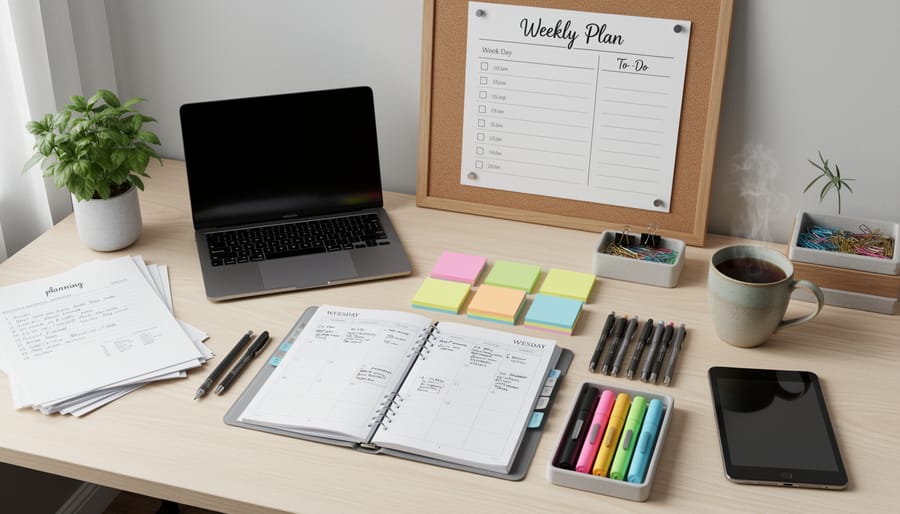
Blocking off a fixed slot each week to plan lessons is one of the simplest ways to reduce last-minute scrambling and keep your teaching aligned with provincial curriculum outcomes. Many Canadian teachers set aside 90 minutes on Friday afternoon or Sunday evening to map out the week ahead, prepare materials, and review pacing guides for subjects like literacy and math.
This routine lets you see the week as a whole rather than piecing together lessons each morning. You can check that your activities hit the required learning goals, gather printables or manipulatives in one trip to the copy room, and spot any gaps before they cause stress. It also helps you balance content across days, so you are not cramming three science experiments into one afternoon or leaving numeracy to the last period every day.
For newcomer teachers, weekly planning blocks offer a chance to become familiar with Canadian curriculum documents and adjust pacing if holidays or professional development days interrupt the schedule. Once the habit is in place, you will start each Monday confident that your materials are ready and your lessons flow logically toward the outcomes students need to meet.
2. Digital Lesson-Plan Templates
Digital lesson-plan templates eliminate the blank-page problem and make planning faster. Instead of recreating structure every time you sit down to plan, a reusable template provides consistent fields for curriculum codes, learning goals, materials, procedures, differentiation notes, and assessment criteria. Many Canadian teachers use Google Docs, Microsoft OneNote, or their school board’s learning management system (Edsby, D2L, Google Classroom) to store and duplicate templates.
A solid template includes a header for the date, subject, grade, and provincial curriculum expectation codes, so when you’re reporting or reviewing your term plan, you can quickly verify coverage. Add sections for key vocabulary, accommodations for students with IEPs, and links to digital resources. This consistency reduces mental load: you follow the same workflow each time, freeing up cognitive energy for the creative parts of teaching.
Templates also make life easier for supply teachers. When you’re absent, a substitute can open your plan, see exactly what to teach, where materials are stored, and how to assess completion. Keep a shared folder of your templates and recent lesson plans accessible to administration and supply staff. Update your template termly as you refine what information you actually need at a glance.
3. Classroom Zones for Materials
Dividing your classroom into clearly defined zones transforms chaos into calm and helps students navigate the room independently. When materials have a predictable home, you spend less time answering “Where is the glue?” and more time teaching. This is especially helpful for students who are new to Canada and may benefit from visual cues as part of their cultural adjustment tips.
Start by mapping out these typical zones:
- Teacher workspace: desk, filing cabinet, and personal supplies
- Student cubbies or lockers: individual storage for backpacks and personal items
- Resource station: shared supplies like pencils, scissors, markers, and paper
- Group work area: tables or floor space for collaborative activities
- Quiet or reading corner: soft seating and book bins
- Technology station: computers, tablets, or charging area
Label each zone in English and, where possible, in students’ home languages. Use picture labels for younger learners. Place bins at student height so they can retrieve and return materials without asking. This reduces interruptions during lessons and builds responsibility. Revisit the zones every few weeks to adjust based on what’s actually working.
4. Colour-Coded Subject Folders
Assign each subject area a distinct colour, blue for math, green for science, red for language arts, yellow for social studies, and use it consistently across your teacher files, student folders, and classroom materials. This visual system lets you and your students locate the right resources at a glance, no reading required.
For your own filing, use colour-coded hanging folders, binders, or drawer labels. When students need to grab their math folder, they reach for blue. When you’re prepping a science lesson, you pull the green binder. The system works especially well in multi-grade classrooms, where you might teach Grade 3 and 4 math back-to-back, or in specialist roles (music, French, physical education) where you see multiple classes and need fast transitions between groups.
Ask students to label their own folders or duotangs with the matching colour at the start of term. Younger learners benefit from colour cues when literacy skills are still developing, and English Language Learners can navigate materials without relying solely on text. Keep a colour key posted near your storage area so supply teachers and student helpers can maintain the system in your absence.
5. Daily Routines and Visual Schedules
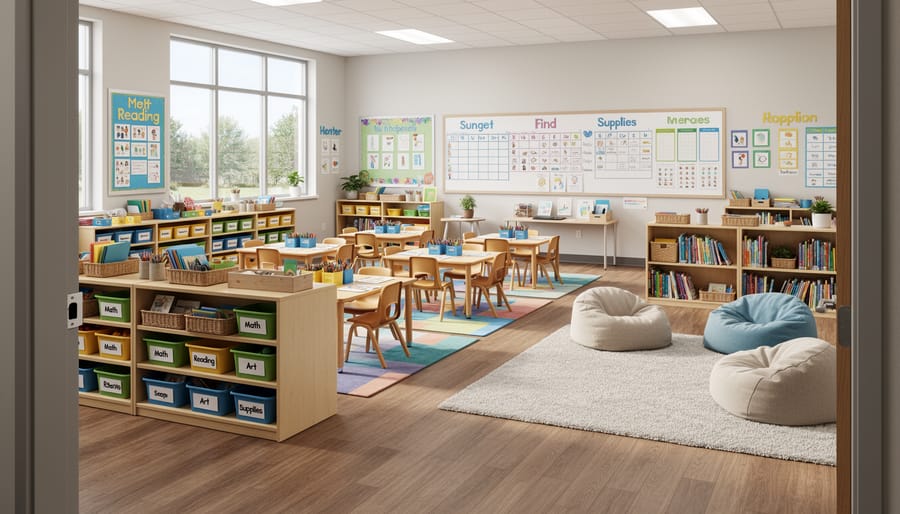
A predictable daily schedule anchors your classroom and cuts down transition time dramatically. Post a large, visual timetable where every student can see it, use icons or colour blocks alongside text so younger learners and English Language Learners (ELLs) grasp the flow without relying solely on reading. Include morning circle, subject blocks, recess, lunch, and dismissal time. When students know what comes next, they settle faster and anxiety drops.
Newcomer Tip: Many Canadian classrooms begin the day with a land acknowledgment, recognizing the Indigenous peoples on whose traditional territory the school stands. Weaving this practice into your routine models respect and aligns with the K, 12 curriculum emphasis on Indigenous perspectives. Keep it brief, age-appropriate, and genuine, students will come to see it as part of the classroom rhythm.
Update the schedule each morning by checking off completed activities or moving a visual marker (clothespin, magnet). This simple act reinforces structure, helps students who thrive on routine, and gives everyone a shared reference point when plans shift unexpectedly.
6. Student Work Inbox and Outbox System
Set up dedicated spots where students submit completed work and collect graded assignments. A clear inbox and outbox system eliminates the paper chase and puts accountability on students.
For physical systems, use wall-mounted file organizers with labeled slots for each class period or subject. Place an “inbox” basket near the door where students drop homework as they enter. Keep an “outbox” on a shelf or table where graded work sits ready for pickup. Label everything clearly: “Math Inbox, Period 2” or “Returned Work, Pick Up Here.”
Digital systems work similarly. Create folders in your school’s learning management system or shared drive: one for “Submit Here” and another for “Graded Work.” Students upload assignments to the submit folder, you move marked files to the graded folder, and they download feedback on their own time.
The benefits add up quickly. You spend less time tracking down missing assignments or fielding “Did you mark mine yet?” questions. Students learn responsibility by checking for feedback themselves. At report card time, you have a running archive instead of a desk buried in papers.
Establish the routine in the first week and model it daily until it becomes automatic.
7. Assessment Tracking Spreadsheets
A simple assessment tracking spreadsheet transforms report card season from chaos into calm. Set up columns for student names, assignment titles, dates, marks or achievement levels, and notes on progress toward specific provincial learning outcomes (the curriculum codes your province uses). This running record makes parent-teacher conferences straightforward, you can pull up a student’s formative quizzes, observations, and summative projects in seconds rather than hunting through piles of paper. Many teachers keep one tab per subject or term, colour-coding cells to flag students needing extra support or enrichment. This approach pairs well with an academic planner for mapping assessment due dates across the year.
Privacy matters: never store student data on personal devices or cloud accounts without your board’s permission. Use your school division’s official gradebook software when provided, or keep spreadsheets on a password-protected school laptop and follow local data protection policies. If you’re tracking sensitive information like accommodations or behavioural observations, check with administration about secure storage. A well-maintained tracker not only saves hours during reporting, it also documents your professional judgment and helps you spot learning trends before they become problems.
8. Communication Logs for Parent Contact

Keeping a dated log of every parent and guardian contact sounds tedious, but it is one of the most protective and trust-building habits you can adopt in a Canadian K, 12 classroom. A simple communication log documents when you reached out, what was discussed, and what was agreed, invaluable during report-card conferences, behaviour escalations, or if a misunderstanding arises.
Set up a basic table with six columns: date, student name, contact method (email, phone, in-person), topic, outcome, and follow-up required. For example, “2026-08-05, Aisha Khan, email, missing math homework, parent will check backpack nightly, follow up Friday.” This takes 30 seconds per entry but creates a clear trail.
The log helps you celebrate wins, too. Recording a quick call to share a student’s reading breakthrough builds positive relationships and shows families you notice growth, not just problems. It also reminds you to circle back on promises made, which strengthens trust.
Store your log in a password-protected spreadsheet or locked notebook, following your school board’s privacy policies. Many boards prohibit storing student data on personal devices, so check local guidelines. Review the log before parent-teacher interviews to refresh your memory and demonstrate professionalism. This small system protects you, respects families, and keeps communication transparent.
9. To-Do Lists with Priority Flags
A simple to-do list with priority flags cuts through the fog of competing demands and helps you tackle what truly matters first. Start each week by listing tasks, marking assignments, prepping tomorrow’s science lesson, attending a team meeting, reading the new IEP draft, then tag each one: urgent, important, or can wait. Urgent tasks have imminent deadlines or affect student safety. Important work advances learning goals or professional growth but tolerates a short delay. Everything else gets a ‘can wait’ label, which you review only after the other two categories are done.
Paper planners, bullet journals, or apps like Todoist and Trello all work; pick whichever you’ll check daily. The key is honest triage. Not everything is urgent, and saying no to low-impact requests protects the prep time you need to teach well. Block that prep period in your calendar and guard it the way you’d guard instructional time. Canadian teachers often juggle extra duties, supervision rotations, and professional learning modules, so ruthless prioritization keeps you from drowning. When your list clarifies where your energy goes, you finish each day knowing you moved the needle on what counts.
10. Shared Resource Drives with Colleagues
Setting up shared cloud folders with your grade-level or subject team cuts down duplicate work and gives everyone access to lesson plans, templates, assessments, and differentiated resources. Most Canadian school boards already use Google Workspace or Microsoft 365, so creating a shared drive takes minutes.
Start by organizing folders clearly: one for each unit or term, subfolders for lesson plans, handouts, rubrics, and adapted materials. Label files with descriptive names and dates so colleagues can find what they need quickly. For example, “Grade 4 Multiplication Unit, Week 2 Anchor Chart.pdf” is more useful than “Math Thing.pdf.”
When you use or adapt a colleague’s resource, ask permission first and credit them, even in a shared space. Teaching materials reflect hours of planning, and respecting intellectual effort builds trust within your team. If you modify a file, save it under a new name rather than overwriting the original.
Shared drives are especially valuable for newcomer teachers unfamiliar with Canadian curriculum expectations or provincial reporting language. You gain immediate access to proven resources, see how experienced colleagues structure lessons, and contribute your own culturally responsive materials, such as multilingual vocabulary lists or global perspectives, that enrich the whole team’s practice.
11. Substitute Teacher Binders
A well-stocked substitute teacher binder, or digital equivalent, can save you and your supply teacher considerable stress when you’re absent. In Canadian schools, occasional teachers are often booked with minimal notice, sometimes the same morning. A clear, organized binder ensures your class runs smoothly even without you there.
Include the essentials: a current class list with pronunciation notes for students’ names, the daily schedule with recess and lunch timings, seating plan, and any students with medical alerts or accommodations. Add a one-page behaviour management overview, your classroom rules, reward system, and who to contact for support. Attach emergency procedures (fire drill route, lockdown protocol) specific to your school.
Most importantly, prepare one or two days of self-contained, no-prep lessons. Think review worksheets, independent reading tasks, or educational videos with reflection questions that align with your current unit. Label each activity by subject and approximate duration.
Store the binder in a visible, labeled spot on your desk. Update it every term as class lists, schedules, and units change. A digital version saved on your school’s shared drive works too, provided the supply teacher can access it easily. This small investment protects instructional time and gives you peace of mind when illness or emergencies arise.
12. End-of-Day Reset Routine
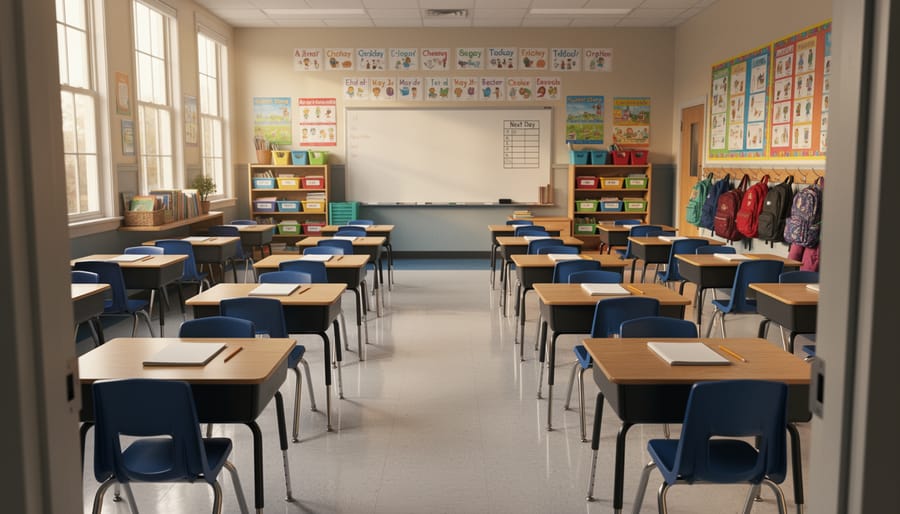
A 10-15 minute reset at the end of each school day prevents the overwhelm of walking into a cluttered classroom the next morning. This routine involves tidying materials back into their labelled zones, filing completed student work into the inbox system, updating tomorrow’s lesson plan or visual schedule with any last-minute changes, and resetting high-traffic areas like the carpet or supply station.
Canadian teachers often face tight turnarounds between dismissal and evening commitments. A quick reset helps you leave school feeling organized rather than defeated, which supports work-life balance, especially important for newcomer teachers adjusting to a new education system and culture.
The routine also models responsibility for students who help with classroom jobs during the final minutes. Consider a checklist: clear desk, refill markers, update board, check emails briefly, lock up. This boundary between school and home protects your personal time and reduces the temptation to carry work home every night, a challenge many Canadian educators report. Consistency here compounds: small daily effort prevents weekend catch-up marathons.
Province-by-Province Organizational Considerations
Canada’s K, 12 education system is provincially governed, which means organizational requirements vary by region. Understanding these differences helps you build systems that meet local expectations.
Ontario uses the Growing Success assessment framework. Report cards typically go out in November, March, and June. You’ll manage Individual Education Plans (IEPs) through ministry templates, and most boards use PowerSchool for marks and attendance. Keep curriculum expectations from the provincial policy documents handy, they’re organized by strand and grade.
British Columbia structures learning around curricular competencies and big ideas rather than specific outcomes. Reporting happens three times per year, often with narrative comments. Many districts use MyEducation BC or FreshGrade for portfolios and communication. The Ministry’s redesigned curriculum is fully digital, so bookmark the pages you reference often.
Alberta follows Programs of Study organized by subject and grade. Progress reports and final reports vary by division, but student learning assessments (SLAs) and individualized program plans (IPPs) require careful documentation. PowerSchool or Edsby are common platforms. Track diploma exam schedules if you teach high school courses.
Quebec operates in French and English systems with distinct cycles and competency frameworks. Bulletin reports align with terms (étapes). Check your school board’s specific evaluation policies and MEES guidelines.
Other provincesManitoba, Saskatchewan, the Atlantic provinces, each have unique curriculum frameworks, reporting cycles, and mandatory documentation. Ask your principal or department head for board-specific checklists, templates, and deadlines during orientation. Provincial teacher association websites often post planning resources too.
Making These Strategies Work for You
You don’t need to implement all twelve strategies at once. Pick two or three that directly address your biggest organizational challenges right now, maybe weekly planning blocks if you’re scrambling each morning, or a communication log if parent emails feel overwhelming. Try them for a few weeks, adjust what doesn’t fit your rhythm or your school’s systems, and add another strategy once the first ones feel automatic.
Newcomer teachers especially should remember that Canadian colleagues are usually generous with templates, advice, and encouragement. Ask your mentor or a grade-partner to show you their lesson-plan template or student-work inbox setup. Most teachers understand the learning curve and are happy to share what’s already proven effective in your building.
Good organization isn’t about rigid control or checking boxes. It’s about creating space, space to notice when a student needs extra support, space to try a new lesson idea, space to leave school at a reasonable hour and recharge. The goal is to spend less time hunting for papers or rewriting plans from scratch, and more time doing the relationship-building and creative teaching that drew you to the profession in the first place. Review your systems at the end of each term, keep what helps, and let go of what doesn’t. Organization should serve you, not the other way around.
Frequently Asked Questions
How much time should I spend on organization each week?
Most teachers find that 60 to 90 minutes of focused organizational work per week, such as updating trackers, filing materials, and planning ahead, saves hours of scrambling later. Build it into your schedule the same way you would mark a lesson or attend a meeting.
What if my school doesn’t provide enough planning time?
Advocate through your union or professional association for adequate prep periods, which are often outlined in collective agreements. In the meantime, protect the time you do have by batching similar tasks and saying no to non-essential requests.
Can I use my own apps and tools or must I use the board’s?
Check your school board’s acceptable use and privacy policies first. Many boards allow personal productivity tools as long as student data stays on approved platforms like the board’s LMS or gradebook.
How do I balance organization with flexibility?
Strong systems create the breathing room for spontaneity, not rigidity. Keep your core routines consistent but leave buffer time in lesson plans and be ready to adjust when students need more support or an unexpected opportunity arises.
Are there copyright rules for sharing resources in Canada?
Yes. Canadian schools operate under education-sector copyright licenses, but always credit original creators, respect terms of use, and ask permission before adapting or redistributing a colleague’s or publisher’s materials.
These questions reflect the real concerns teachers voice when adopting new organizational strategies. If you are a newcomer teacher, don’t hesitate to ask colleagues or your department head for clarification on local board policies, most Canadian educators are happy to share what works in their context. The goal is not perfection but finding a rhythm that lets you teach with confidence and leave work at a reasonable hour.