
Game-based learning (GBL) is an instructional approach that uses games to teach curriculum content and skills, either through purpose-built educational games or by integrating game elements like points, levels, and challenges into classroom activities. When your child’s teacher in Toronto announces a math unit taught through Minecraft, or a Vancouver school mentions students earning badges for reading milestones, that’s game-based learning in action.
Canadian K-12 schools increasingly use GBL because research shows it boosts student engagement, helps learners practice problem-solving in low-risk environments, and accommodates different learning speeds and styles. For international families evaluating Canadian schools, understanding GBL helps you recognize innovative teaching methods your child will encounter. For international teachers preparing to work in Canada, familiarity with GBL is practical: many provincial curricula now explicitly encourage game-based strategies, particularly in STEM subjects and literacy development.
GBL isn’t simply “playing games during class.” Effective game-based learning connects game mechanics directly to learning outcomes. A Grade 5 science game about ecosystems, for example, requires students to balance predator-prey relationships and observe cause-and-effect, reinforcing curricular concepts through interactive decision-making rather than worksheets.
This article breaks down what game-based learning means in Canadian classrooms, how it works in practice, the main types you’ll see (digital games, board games, gamification systems), and why schools from British Columbia to Nova Scotia are adopting these methods. Whether you’re comparing schools for your family or preparing your teaching portfolio, you’ll find clear explanations and real Canadian classroom examples ahead.
What Is Game-Based Learning? Definition and Core Principles
Game-based learning (GBL) is an instructional approach in which students learn curriculum content and skills by playing games designed or adapted for educational purposes. In K, 12 classrooms, this means students might solve math problems through a digital quest, practice vocabulary by playing a card game, or explore historical events through a role-playing simulation. The game itself becomes the vehicle for learning, not just a reward tacked on after the lesson.
GBL is often confused with related terms, so it helps to clarify the differences. Gamification vs game-based learning is a common point of confusion: gamification applies game elements (points, badges, leaderboards) to non-game activities, while game-based learning uses actual games as the core learning experience. Educational games are explicitly designed for teaching, whereas serious games may serve broader purposes like training or awareness. Here’s a quick breakdown:
- Game-Based Learning
- An instructional method where students learn by playing games that teach specific curriculum outcomes; the game is the lesson.
- Gamification
- Adding game-like features (points, levels, rewards) to traditional classroom tasks to increase motivation; the lesson stays the same, but feels more game-like.
- Educational Games
- Games purpose-built for teaching, such as apps that drill multiplication facts or board games that teach geography.
- Serious Games
- Games designed with a purpose beyond entertainment, which can include education, professional training, or public awareness.
Four core principles underpin effective game-based learning in Canadian K, 12 classrooms. First, engagement: games capture attention and sustain interest through story, competition, or collaboration. Second, challenge: well-designed games present problems at the right difficulty level, stretching students without overwhelming them. Third, feedback: games provide immediate, specific responses to student actions, helping learners adjust their strategies in real time. Fourth, agency: students make meaningful choices within the game, which fosters ownership and deeper thinking. These principles of student agency and feedback are what distinguish true game-based learning from passive educational entertainment.
A Grade 5 class in Toronto might use Minecraft Education Edition to design sustainable cities, applying geometry and environmental science concepts. A Grade 9 French immersion class in Vancouver might play a role-playing game set in Francophone Africa, practicing language skills while exploring cultural geography. In both cases, the game drives the learning, and the teacher facilitates deeper understanding through observation and discussion.
How Game-Based Learning Works in K, 12 Classrooms
Where Game-Based Learning Fits in the Curriculum
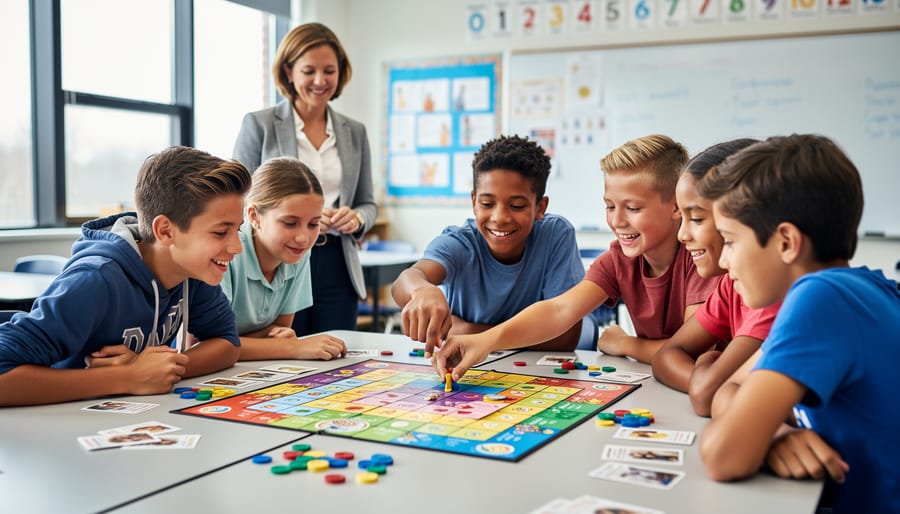
Game-based learning isn’t an add-on or a break from real teaching, it’s a strategy teachers use to meet official curriculum expectations. In Canadian K, 12 classrooms, provincial curricula outline specific learning outcomes for every subject and grade, and well-designed games help students reach those outcomes while staying engaged.
In mathematicsgames reinforce number sense, operations, patterns, and problem-solving. A Grade 3 class in Ontario might use fraction games to meet expectations around representing and comparing fractions, while Alberta high school students tackle logic puzzles that align with outcomes in algebraic reasoning.
Science curricula emphasize inquiry and the scientific method. Games that simulate ecosystems, chemical reactions, or physics challenges let students test hypotheses and observe outcomes, matching expectations around experimentation and evidence-based thinking found in BC’s science curriculum.
In social studiesrole-play and simulation games help students explore historical events, government systems, or cultural perspectives. A Grade 7 Quebec class might play a confederation negotiation game to meet outcomes on Canadian history and civic understanding.
Language arts outcomes, reading comprehension, vocabulary, storytelling, collaboration, are embedded in narrative games, word challenges, and group discussion games. Teachers choose games that directly target the skills and knowledge students need to demonstrate, ensuring GBL supports rather than replaces curriculum-focused instruction.
The Teacher’s Role in Game-Based Learning
Teachers in Canadian K, 12 classrooms act as designers, facilitators, and guides during game-based learning. Before the activity, they select or adapt games that match specific curriculum outcomes, prepare materials, and plan scaffolding strategies to support diverse learners. Strong teacher organization ensures smooth transitions and clear instructions, especially when managing multiple game stations or digital platforms simultaneously.
During gameplay, teachers observe student interactions, ask probing questions, and provide just-in-time support without taking over. They watch for misconceptions, monitor group dynamics, and adjust difficulty on the fly. This facilitation helps students stay focused on learning goals rather than simply playing.
After the game, teachers lead structured debriefing sessions where students reflect on strategies, discuss what they learned, and connect game experiences to broader curriculum concepts. This consolidation phase transforms play into lasting understanding. Teachers also assess learning through observation notes, student reflections, and performance on related tasks. For international teachers, mastering this three-phase approach is essential: Canadian schools expect educators to actively facilitate learning rather than simply deliver content, and game-based learning exemplifies this facilitation-focused pedagogy.
Types of Game-Based Learning in K, 12 Schools
Digital and Online Game-Based Learning
Digital games and online platforms offer interactive, self-paced learning experiences that can adapt to each student’s skill level. In Canadian classrooms, teachers commonly use platforms like Minecraft Education Edition for collaborative building projects in science and social studies, Prodigy Math for practising arithmetic aligned with the K to 12 curriculum and Kahoot! for quick knowledge checks. These tools provide instant feedback, track progress, and let students retry challenges, features that support differentiated instruction and help English language learners build vocabulary in low-pressure settings.
Access varies across schools and provinces. Urban districts often provide devices and reliable internet, while rural or under-resourced schools may have limited tech infrastructure. Some families worry about screen time or unequal access at home. Teachers address equity by offering non-digital alternatives, using shared classroom devices, and ensuring game-based activities complement, not replace, hands-on learning. International families should ask schools about their technology policies and borrowing programs to understand what students will use in class.
Board Games, Card Games, and Manipulatives
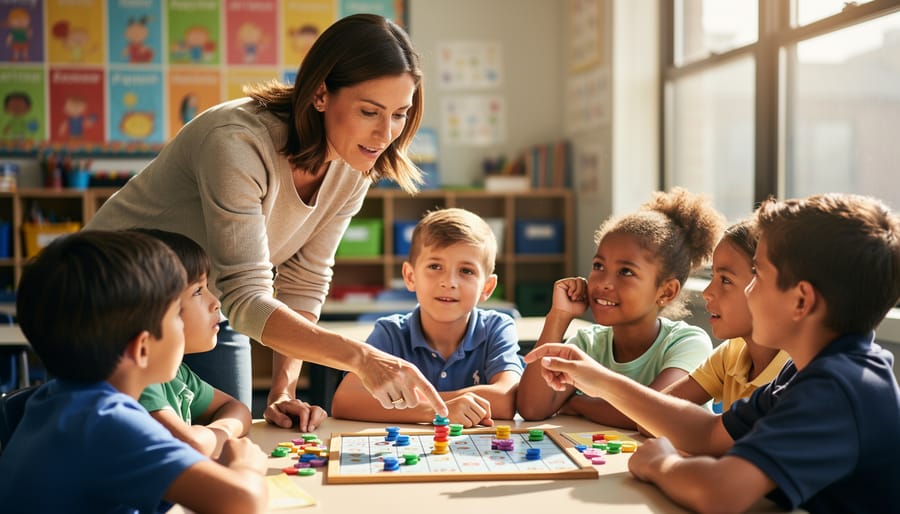
Board games, card games, and hands-on manipulatives remain staples in Canadian K, 12 classrooms, especially in elementary and middle grades. These non-digital games build strategic thinking, numeracy, literacy, and collaboration without requiring screens or internet access.
Teachers use classics like chess clubs, math-focused card games (e.g., fraction war, place-value bingo), and pattern blocks to reinforce concepts through play. Cooperative board games teach turn-taking and shared problem-solving, while strategy games like Settlers of Catan or Blokus appear in enrichment programs and after-school clubs.
Manipulatives, tangible objects such as base-ten blocks, algebra tiles, and letter tiles, bridge concrete and abstract learning. Students physically arrange pieces to visualize operations, spelling patterns, or geometric properties, making abstract ideas accessible to diverse learners. Non-digital games also support multilingual students, who can participate through observation and action before mastering academic language.
Role-Play, Simulations, and Scenario-Based Games
Students step into the role of a town councillor debating a new park, a scientist responding to an oil spill, or a historical figure navigating Confederation. These immersive scenarios ask learners to make decisions, weigh evidence, and see consequences unfold, skills central to social studies and science curricula across Canada.
Role-play and simulation games work especially well for complex, open-ended topics. A Grade 10 Alberta class might simulate Treaty 7 negotiations, exploring multiple perspectives and historical context. In British Columbia science classrooms, students use ecosystem simulations to test the impact of invasive species or climate variables, observing cause and effect in real time.
Teachers guide the setup, provide roles or scenarios, then facilitate discussion afterward to deepen understanding. For newcomer students, these games build confidence in speaking, collaboration, and grappling with Canadian content in a low-stakes, supportive environment.
Physical and Movement-Based Games
Physical and movement-based games engage students through active play, especially valuable in primary grades and physical education classes. Teachers use games like relay races with math challenges, freeze dance for vocabulary review, and outdoor scavenger hunts that connect to science concepts. These kinesthetic learning games support students who learn best through movement while building motor skills, spatial awareness, and teamwork. Many Canadian schools emphasize outdoor learning and wellness, so teachers often take games outside, students might measure distances, identify plants, or role-play historical journeys. Movement-based games also create inclusive entry points for English language learners and newcomer students, as physical cues and gestures reduce language barriers and build confidence.
Uses and Benefits of Game-Based Learning for K, 12 Students
Game-based learning delivers measurable benefits that matter to K, 12 students, their families, and teachers working in Canadian classrooms. At its core, GBL increases student engagement by tapping into intrinsic motivation: when learning feels like play, students invest more effort, persist through challenges, and retain concepts longer. Research conducted in Ontario and British Columbia classrooms shows that students who participate in well-designed game-based activities demonstrate higher levels of on-task behaviour and report greater enjoyment of subjects they previously found difficult.
Beyond engagement, game-based learning builds critical 21st-century skills that prepare students for success in school and beyond. Games naturally require players to think critically, analyze information, make decisions under constraints, and adapt strategies when things go wrong. Collaborative games teach teamwork, communication, and conflict resolution as students negotiate roles, share resources, and work toward common goals. Problem-solving becomes experiential rather than abstract: a grade 7 student designing a sustainable city in a simulation game learns systems thinking and resource management while applying math, science, and social studies concepts simultaneously.
Game-based learning also excels at differentiated instruction, meeting students where they are. Digital games often adjust difficulty automatically, while board games and role-play activities allow teachers to modify rules, provide scaffolds, or assign different roles based on readiness. This flexibility proves especially valuable for newcomer students and multilingual learners navigating Canadian classrooms. Games reduce language barriers through visual cues, hands-on interaction, and context-rich scenarios; a student still building English proficiency can demonstrate understanding through gameplay choices rather than written explanations alone. Many Canadian teachers report that games create inclusive spaces where international students contribute confidently, building both academic skills and social connections that support cultural adjustment.
Finally, games provide a safe space for trial and error. Students can take risks, test hypotheses, fail, and try again without the anxiety that accompanies traditional high-stakes assessment. This iterative process mirrors real-world learning and fosters resilience, creativity, and a growth mindset. For families considering Canadian schools, understanding these benefits helps explain why teachers invest time in game-based activities and how such approaches support your child’s holistic development.
Game-Based Learning Across Canadian Provinces
Game-based learning shows up differently across Canada’s provinces, shaped by each region’s curriculum framework, tech investments, and professional development priorities. Understanding these variations helps international families choose schools that match their children’s learning styles and helps teachers who want to become a teacher in Canada prepare for provincial expectations.
Ontario emphasizes game-based learning in STEM subjects, with many boards investing in coding platforms and robotics competitions. The province’s renewed curriculum encourages inquiry and problem-solving through digital and hands-on games. British Columbia’s competency-based curriculum gives teachers wide flexibility to use games for inquiry-based learning across all subjects, from Indigenous storytelling games in social studies to collaborative math challenges. Alberta’s curriculum redesign highlights competencies like critical thinking and collaboration, opening space for game-based approaches; many Alberta teachers use games to teach financial literacy, citizenship, and environmental science. Quebec integrates game-based learning with a focus on digital citizenship and French-language educational platforms, particularly in primary and middle years.
- Ontario, STEM focus with coding, robotics, and math game platforms
- British Columbia, inquiry-based learning across subjects with high curriculum flexibility
- Alberta, competency framework encouraging problem-solving and collaboration games
- Quebec, digital citizenship emphasis with French-language educational games
- Atlantic Canada, community-based and place-based games, often integrating local culture and history
Atlantic provinces often use community-based and place-based games that connect students to local history, geography, and culture. Teacher professional development varies: British Columbia and Ontario offer robust PD on game-based learning through provincial networks, while smaller provinces may rely on district-level or online training. Tech infrastructure also differs; urban schools generally have better access to devices and high-speed internet, while rural and remote schools may favour low-tech or offline games.
For families evaluating schools, ask about the types of games used, how they align with curriculum, and what support is available for multilingual students. For teachers, research the province’s curriculum framework and tech initiatives to see where game-based learning fits your teaching style and professional goals.
What International Students and Families Should Know
If you’re new to Canada, game-based learning may feel unfamiliar, or even surprising, compared to the education system in your home country. Many international families come from school cultures that emphasize direct instruction, textbook drills, and frequent testing. Canadian K, 12 classrooms often balance these methods with more student-centered approaches, including games that teach curriculum content through play and problem-solving.
This doesn’t mean Canadian schools are less rigorous. Teachers use games to deepen understanding, not replace core instruction. Students still complete assignments, write tests, and meet provincial learning standards. Games serve as one tool among many to engage learners and build skills like collaboration, critical thinking, and resilience.
What to Expect in Your Child’s Classroom
Your child may play digital math games on a tablet, use board games to practice vocabulary, or participate in role-play simulations during social studies. These activities are planned to align with specific curriculum outcomes. Teachers observe, guide, and assess learning throughout.
How to Support Game-Based Learning at Home
Ask your child what they played and what they learned. Play simple strategy games together, card games, puzzles, or board games, to reinforce problem-solving and turn-taking. If your child struggles with English or French, games can provide low-pressure practice in a social context.
Questions to Ask Schools
When visiting schools, ask: How do teachers use games in the classroom? How is learning assessed during game-based activities? Are games available in multiple languages or adaptable for newcomers?
Newcomer Tip: If your child is adjusting to a new language or culture, game-based learning can be a bridge. Games often rely on visuals, collaboration, and trial-and-error, which reduce language barriers and build confidence.
Frequently Asked Questions
Is game-based learning used in all grades across Canada?
Yes, game-based learning appears in all K, 12 grades, though the types of games and their complexity vary. Early elementary classrooms often use hands-on manipulatives and movement games, while older students engage with digital simulations, strategy games, and role-play scenarios aligned to curriculum outcomes.
Do students still take regular tests if schools use game-based learning?
Absolutely. Game-based learning complements traditional assessment rather than replacing it. Teachers use games to build skills and understanding, then assess student learning through tests, projects, presentations, and other methods required by provincial curricula.
What if my child doesn’t enjoy playing games?
Not all students love every game, and that’s normal. Teachers typically offer varied activities and different game formats throughout the year, so reluctant students still participate without pressure to compete or perform. The goal is learning through engagement, not forcing enthusiasm for games themselves.
How do teachers assess what students learn from games?
Teachers observe students during gameplay, facilitate reflection discussions afterward, and assign follow-up tasks such as written reflections or problem sets. Many educational games also include built-in progress tracking that teachers review to identify strengths and gaps.
Are educational games available in languages other than English?
Many popular digital platforms offer French and sometimes other languages, especially in bilingual provinces. Non-digital games can often be played in any language, and teachers adapt instructions to support multilingual learners, though availability varies by school and district resources.
Will my child fall behind if their school uses more games than traditional teaching?
Game-based learning is one instructional tool among many, not a replacement for foundational teaching. Schools balance games with direct instruction, independent practice, and collaborative projects to meet curriculum standards, so students develop the full range of skills expected at each grade level.
These questions reflect the most common concerns international families and teachers raise when they first encounter game-based learning in Canadian schools. Parents often worry that games seem less rigorous than the structured lessons they remember from their own education, while teachers new to Canada want to understand how much autonomy they’ll have in choosing and facilitating games.
The reassurance families need most is that games don’t diminish academic expectations. Canadian K, 12 systems hold schools accountable for student achievement through standardized assessments and diploma requirements, so game-based learning must demonstrably support those outcomes. Teachers design game activities with clear learning objectives, assess understanding just as they would after a textbook lesson, and intervene when students struggle.
For newcomer students adjusting to a new school system, game-based learning can actually ease the transition. Games provide low-stakes opportunities to practice English or French, collaborate with classmates, and engage with Canadian curriculum content in a less intimidating format than a traditional test or essay. Teachers trained in inclusive practices use games to differentiate instruction, allowing students at different language or skill levels to participate meaningfully in the same activity.
If you have specific questions about how a particular school integrates game-based learning, ask during school tours or parent-teacher meetings. Understanding the balance between games and other methods will help you support your child’s learning at home and advocate for their needs if adjustments are necessary.
Game-based learning, using structured play to achieve curriculum goals, has become a valued part of K, 12 education across Canada. It engages students, builds critical thinking and collaboration skills, and creates inclusive classrooms where diverse learners can thrive. Whether through digital platforms, board games, role-play simulations, or physical activities, GBL helps teachers make learning active, meaningful, and fun.
For international families exploring Canadian schools, understanding game-based learning gives you insight into how your child will learn and how you can support that learning at home. For international teachers preparing to work in Canada, familiarity with GBL practices will help you adapt quickly to Canadian classrooms and connect with students effectively.
Every province approaches game-based learning differently, but the core principle remains: learning through play works. As you consider schools or teaching opportunities, look for programs that balance traditional instruction with innovative, student-centred methods like GBL.
Study Canada is here to help. Contact us for personalized guidance on choosing the right school for your family or finding the right teaching position to match your skills and goals in Canada’s K, 12 system.