
Choose games that match your child’s developmental stage and align with Canadian early learning expectations. In Canada, pre-kindergarten (pre-K) programs prepare children aged 3–5 for formal schooling through play-based activities that build literacy, numeracy, social-emotional skills, and problem-solving abilities—all foundational elements of the K-12 curriculum. The right learning games make this preparation engaging and effective.
Look for games that target multiple skill areas simultaneously. A simple matching game, for example, strengthens memory, visual discrimination, and turn-taking. Counting bears or pattern blocks develop early math concepts while building fine motor control. Rhyming card games support phonological awareness, a critical pre-reading skill emphasized across all Canadian provinces and territories.
Prioritize free or low-cost options that respect diverse family budgets. Many public libraries across Canada offer board game lending programs, storytelling apps, and printable activity sheets. Community centres frequently host drop-in play sessions with educational materials. Provincial government websites often provide downloadable resources aligned with local early learning frameworks.
Select culturally inclusive games that reflect your family’s background and Canada’s diversity. Games featuring various languages, family structures, and cultural traditions help children see themselves in their learning while building respect for others. This approach supports the welcoming, multicultural classroom environment newcomer families will encounter in Canadian schools.
Verify that games encourage active participation rather than passive watching. Quality pre-K learning tools prompt children to sort, build, create, question, and collaborate—skills that translate directly to kindergarten readiness and long-term academic success.
Why Game-Based Learning Starts Before Kindergarten in Canada
Canada’s approach to early childhood education is built on a simple but powerful idea: young children learn best through play. Across every province and territory, early learning frameworks recognize that games, exploration, and hands-on activities are not just preparation for “real” school—they are the foundation of all future learning. This philosophy shapes what happens in Canadian kindergarten classrooms and explains why pre-K learning games are so valuable for families preparing their children for school entry.
The pan-Canadian early learning framework identifies key developmental domains that provinces use to guide early childhood programs: well-being, play and playfulness, communication and literacies, and problem-solving. Pre-K games naturally support all these areas. When a three-year-old sorts coloured blocks, she is building early math skills. When a four-year-old plays a rhyming card game, he is developing phonological awareness—a critical pre-reading skill. These playful moments build the neural pathways that make formal literacy and numeracy instruction easier once children enter kindergarten.
Canadian kindergarten teachers expect children to arrive with emerging skills in four key areas:
– Literacy foundations: recognizing some letters, understanding that print carries meaning, and enjoying stories
– Numeracy concepts: counting small sets of objects, recognizing shapes, and comparing quantities
– Social-emotional skills: sharing, taking turns, managing frustration, and working with peers
– Fine motor development: holding a pencil, using scissors, and manipulating small objects
Pre-K learning games build these exact skills in low-pressure, engaging ways. A simple board game teaches turn-taking and counting. A puzzle strengthens hand-eye coordination and spatial reasoning. For newcomer families navigating cultural adjustment for newcomers, play-based learning games offer a welcoming, language-flexible entry point into Canadian educational expectations—no prior knowledge of the school system required.
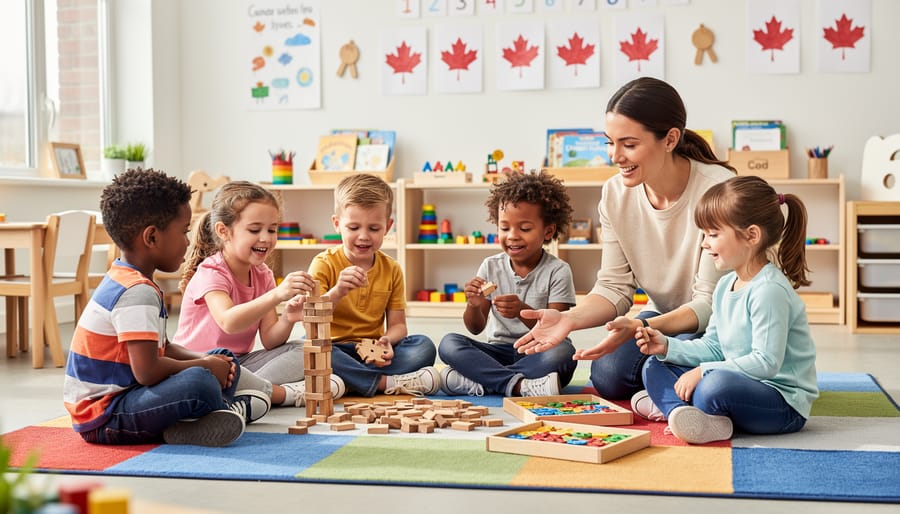
Core Skills Pre-K Games Should Develop
Language and Early Literacy
Language and early literacy skills form the foundation of your child’s school success in Canada. Pre-K learning games help children build vocabulary, recognize letters, and develop listening skills—all essential for a smooth transition to kindergarten, whether your child will learn in English, French, or a bilingual programme.
Rhyming games are a fun starting point. Simple activities like “I Spy” with rhyming words (“I spy something that rhymes with cat”) strengthen phonemic awareness (the ability to hear and play with sounds in words). Many free apps offer interactive rhyming challenges with colourful visuals that keep young learners engaged.
Alphabet recognition games help children connect letters to sounds. Look for apps and board games that say the letter name and sound aloud, then show familiar objects starting with that letter. Digital options often include tracing activities that build pre-writing skills alongside letter knowledge.
Interactive story games encourage listening comprehension and storytelling. Choose games where children predict what happens next, retell stories in their own words, or create alternate endings. Many Canadian public libraries offer free access to bilingual digital storybooks through apps like Tumblebooks.
Newcomer Tip: If your family is learning English or French, choose games that include audio pronunciation and visual supports. Bilingual games can help children build vocabulary in both their home language and their new school language, supporting stronger overall literacy development.
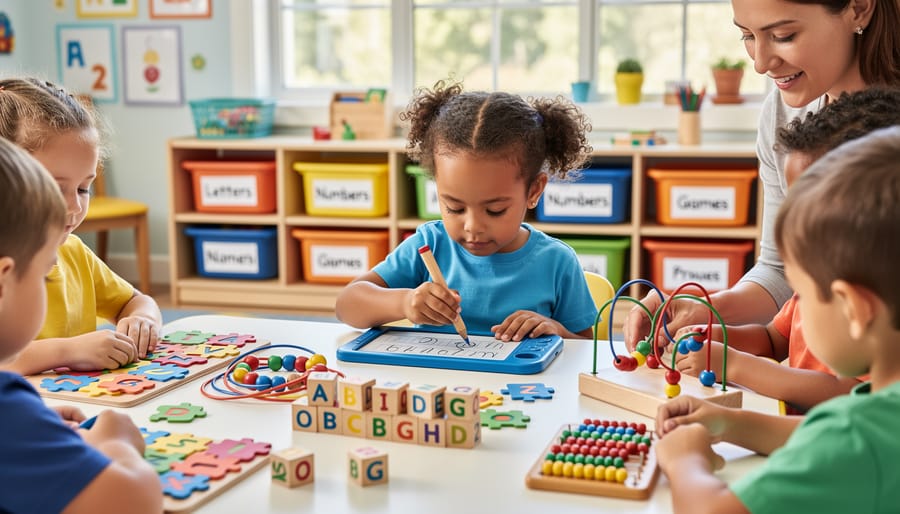
Early Math and Logical Thinking
Building a strong foundation in early math helps pre-kindergarten children develop logical thinking and problem-solving skills. Canadian kindergarten programs introduce number concepts, patterns, and shapes, so familiarizing your child with these ideas through play gives them confidence as they start school.
Number recognition and counting games are excellent starting points. Try simple matching activities where children pair number cards with groups of objects—three apples with the numeral “3,” for example. Counting bears or blocks during play reinforces one-to-one correspondence (understanding that each object gets one number). Digital apps like Endless Numbers or Khan Academy Kids offer interactive counting practice with engaging visuals and audio feedback.
Pattern and sorting games teach children to recognize sequences and categorize items by colour, size, or shape. Create simple AB patterns with household items (red block, blue block, red block) and ask your child to continue the pattern. Sorting buttons, toy cars, or snack items by attribute builds classification skills.
Shape and spatial reasoning activities prepare children for geometry concepts. Puzzles, tangrams, and simple board games with dice help children understand spatial relationships and basic measurement. Look for games that encourage movement and manipulation—stacking cups, nesting boxes, or building with blocks all develop spatial awareness.
Many public libraries across Canada offer free early-learning kits and educational games you can borrow, making these resources accessible regardless of budget.
Social-Emotional and Collaboration Skills
Canadian pre-kindergarten classrooms place strong emphasis on social-emotional learning and collaboration. Young children need safe, playful opportunities to practise sharing, taking turns, recognizing feelings, and working together—skills that form the foundation for later academic success and positive classroom culture.
Turn-taking games like simple board games (Snakes and Ladders, Candy Land) or rolling a ball back and forth teach patience and fairness. Cooperative play activities—building a block tower together, completing a group puzzle, or playing parachute games—help children understand that working as a team achieves more than working alone.
Emotion recognition games support self-regulation and empathy. Try emotion flashcards showing different facial expressions, “feelings charades” where children act out emotions, or picture books that explore how characters feel. Many Canadian early learning frameworks highlight the importance of children being able to name and manage their emotions.
Role-playing scenarios using dress-up clothes, toy kitchens, or pretend doctor kits allow children to step into different perspectives and negotiate roles. A simple grocery store setup or puppet theatre encourages language, cooperation, and problem-solving.
Newcomer Tip: In Canadian classrooms, children are encouraged to use their words to resolve conflicts and express feelings. Games that practise phrases like “Can I have a turn?” or “I feel upset when…” prepare young learners for this collaborative, respectful classroom culture.
Fine and Gross Motor Skills
Pre-kindergarten children develop essential physical skills through hands-on play that prepares them for classroom tasks. Fine motor skills involve small muscle movements needed for writing, cutting, and fastening clothing, while gross motor skills use larger muscles for running, jumping, and balance.
Puzzles are excellent for building hand-eye coordination and problem-solving. Start with large-piece wooden puzzles (4–8 pieces) and gradually increase complexity as your child gains confidence. Look for puzzles featuring familiar objects, animals, or scenes from diverse cultures to support inclusive learning.
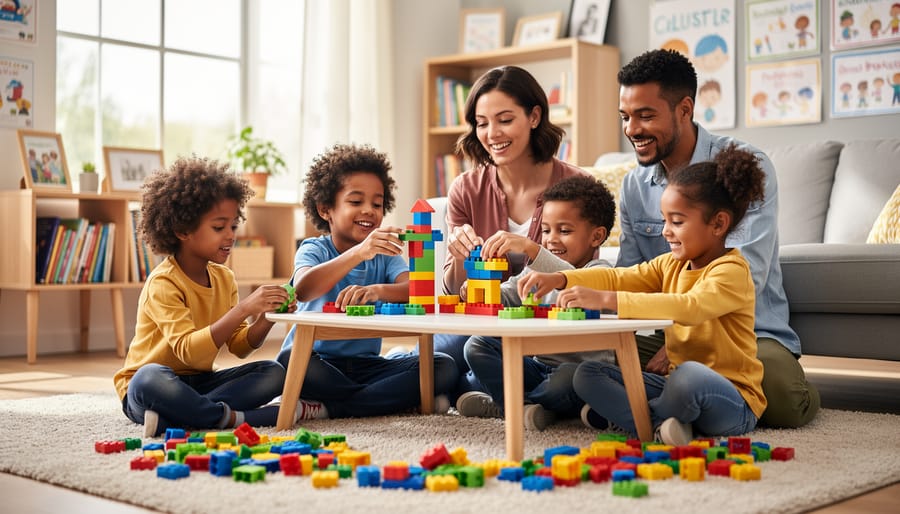
Building blocks and construction toys strengthen finger muscles and spatial reasoning. Duplo, wooden blocks, and magnetic tiles encourage creative building while practicing grip and precision. Many Canadian preschools use block play daily to prepare children for printing and pencil control.
Drawing and colouring apps on tablets can supplement traditional crayon and marker activities. Choose apps with simple interfaces that let children trace letters, draw shapes, or colour pictures. However, balance screen time with real-world practice using chunky crayons, safety scissors, and playdough to develop the hand strength needed for kindergarten tasks.
Movement games like “Simon Says,” dance videos, or outdoor obstacle courses build gross motor skills, body awareness, and the ability to follow multi-step instructions—all important for school readiness.
Newcomer Tip: Many Canadian public libraries offer free toy-lending programs where families can borrow puzzles, blocks, and educational games to try at home before purchasing.
Types of Pre-K Learning Games (Digital and Physical)
Digital Apps and Tablet Games
Age-appropriate educational apps and tablet games can support early literacy, numeracy, and creativity when chosen carefully. The Canadian Paediatric Society guidelines recommend no more than one hour of quality screen time per day for children aged 3–5 years, always with adult supervision and co-engagement.
Look for apps that encourage active participation rather than passive watching. Quality indicators include:
• Open-ended play and creative expression (drawing, building, storytelling)
• Clear learning objectives aligned with early literacy or math concepts
• No advertising or in-app purchases
• Simple, intuitive navigation children can manage independently
• Opportunities for parent involvement or discussion prompts
Many Canadian public libraries offer free access to educational app collections through platforms like Tumblebooks or OverDrive. Before downloading, preview apps yourself to confirm age-appropriateness and educational value. Balance screen-based games with plenty of hands-on, physical play throughout the day. Use apps as a supplement to—not a replacement for—interactive books, conversation, and outdoor exploration.
Board Games and Card Games
Traditional board games and card games offer wonderful opportunities for pre-kindergarten children to practice essential skills in a social, hands-on way. These games help young learners understand turn-taking, counting, colour and shape recognition, and memory—all important foundations for Canadian kindergarten classrooms.
Simple classics work well for this age group. Matching games like Memory (also called Concentration) build visual memory and focus. Use cards with familiar images—animals, fruit, or everyday objects—so children from all backgrounds can participate confidently. Counting games such as Snakes and Ladders or simple dice games introduce number recognition and one-to-one correspondence (matching one object to one count). Colour and shape sorting games, often available as wooden puzzles or lotto boards, reinforce early math concepts.
Newcomer Tip: Many public libraries across Canada lend board games and puzzles for free. Ask at your local branch—it’s a budget-friendly way to try new games before purchasing.
Look for games with minimal text and clear visual cues. This ensures accessibility for children still learning English or French and for families adjusting to a new language environment. Co-operative games, where players work together toward a shared goal rather than competing, can ease anxiety and build teamwork skills valued in Canadian early learning settings.
Hands-On Activity Games
Hands-on activities give pre-K children opportunities to explore concepts through touch, movement, and creativity. These games build fine motor skills, problem-solving abilities, and self-expression—all important foundations for kindergarten success across Canada.
Popular hands-on learning games include:
• Manipulatives: Connecting blocks (Lego Duplo, Mega Bloks), pattern blocks, linking cubes, and sorting trays help children understand spatial relationships, patterns, and early math concepts like sorting and counting.
• Building toys: Wooden blocks, magnetic tiles, and construction sets encourage planning, balance, and teamwork. Children practice measuring, comparing sizes, and following (or creating) simple designs.
• Sensory bins: Containers filled with rice, dried beans, water beads, or sand with scoops, funnels, and small toys support sensory exploration and vocabulary development as children describe textures and actions.
• Art projects: Playdough, finger painting, collage materials, and child-safe scissors develop hand strength and coordination needed for printing and self-care tasks.
• Dramatic play materials: Dress-up clothes, toy kitchens, doctor kits, and multicultural dolls let children role-play real-world situations, practice social skills, and explore different perspectives.
Newcomer Tip: Many public libraries in Canada offer free toy and manipulative lending programs, allowing families to borrow hands-on learning materials at no cost.
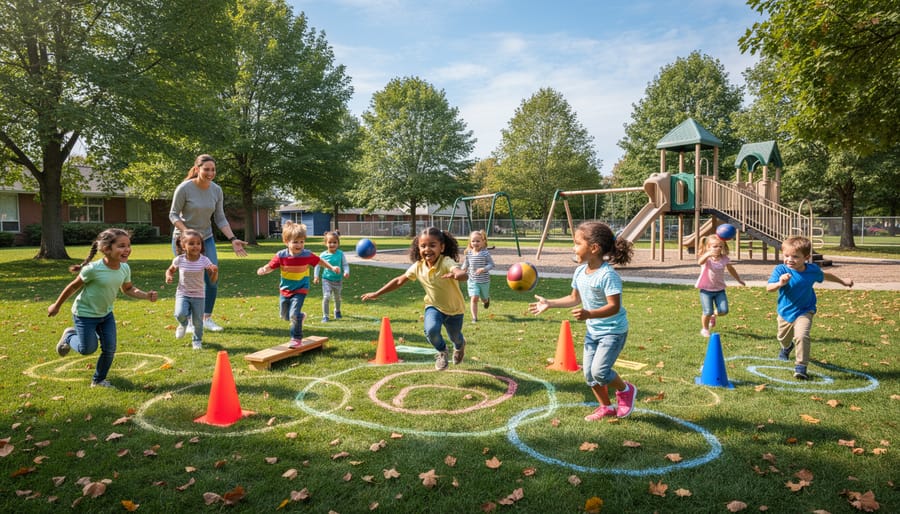
Outdoor and Movement Games
Canadian early learning frameworks celebrate outdoor play year-round, even in winter. Active games build gross motor skills—running, jumping, balancing, and coordination—that prepare children for school routines and playground confidence.
Tag variations work well: try “Colour Tag” (children freeze when tagged, then name a colour to be freed) or “Animal Tag” (move like the animal called out). These games reinforce vocabulary, listening skills, and teamwork.
Scavenger hunts connect to Canada’s outdoor education culture. Create simple picture lists for pre-readers: find a pinecone, yellow leaf, smooth rock, or bird feather. This strengthens observation, sorting, and early science concepts. Adapt hunts indoors during extreme weather using household items.
Obstacle courses develop balance and problem-solving. Use chalk, hula hoops, or safe household items: hop on one foot, crawl under a blanket tunnel, balance a beanbag on your head. Rotate stations weekly to maintain interest.
Newcomer Tip: Many Canadian schools emphasize daily outdoor time regardless of weather. Dress children in layers and waterproof gear so they can enjoy active play comfortably.
Aim for 60 minutes of active play daily, broken into shorter sessions for younger children.
Choosing Quality Pre-K Learning Games: A Checklist
Not all pre-k games are created equal. Whether you are choosing apps, board games, or online activities for your three- to five-year-old, a few simple checks can help you select resources that truly support learning while respecting your child’s development and background.
Use this checklist to evaluate any pre-k learning game:
- Age-appropriate challenge: The game matches your child’s current skills and offers gentle next steps without causing frustration.
- Clear learning goal: You can identify what skill the game teaches (for example, counting, letter recognition, or turn-taking).
- Active participation required: Your child makes choices, solves problems, or creates something rather than passively watching.
- Culturally inclusive: Characters, images, and scenarios reflect diverse families, languages, and traditions.
- Minimal or no advertising: The game is free from distracting pop-ups, in-app purchases, or commercial interruptions.
- Safe and private: No personal data is collected from your child, and parental controls are available.
- Supports interaction: The game encourages conversation, collaboration, or play with caregivers and peers.
Games that meet these criteria align well with Canadian early learning frameworks, which emphasize play-based, child-centered approaches that honour each learner’s identity.
Watch for these red flags that signal a game may not be suitable:
Excessive advertisements or upselling can distract young learners and pressure families into purchases. Content meant for older children—such as complex rules, competitive scoring, or themes involving violence—can overwhelm or confuse preschoolers. Games that require only tapping or swiping with no decision-making offer little educational value. Be cautious of apps or platforms that request unnecessary permissions or lack clear privacy policies.
Before committing to a paid game, preview free trials or read reviews from other parents and educators. Many Canadian public libraries offer free access to educational app collections and game kits you can borrow to try at home. Ask your child’s educator what games they use in the classroom; consistency between home and school reinforces learning and builds confidence for newcomers adjusting to a Canadian early childhood environment.
Where to Find Pre-K Learning Games in Canada
Canada offers many free and low-cost resources to help your pre-kindergarten child learn through play. Here’s where to start, even if you’re new to the country.
Public Libraries
Your local public library is an excellent first stop. Most library branches across Canada offer:
• Free early literacy programs (storytime, rhyme time, play groups)
• Borrowing privileges for educational board games, puzzles, and activity kits
• Access to tablets with pre-loaded learning apps
• Quiet play spaces with learning toys
Simply visit your nearest branch with proof of address to register for a free library card. Staff can guide you to age-appropriate materials in multiple languages.
Community Centres and Family Resource Centres
Many municipalities run family drop-in programs where children can access learning games at no cost. Look for:
• Toy lending libraries (borrow games for 2–3 weeks)
• Parent-child playgroups with guided activities
• Seasonal workshops on early learning
Check your city or township website under “Recreation” or “Family Services.”
Free Provincial Early Learning Resources
Each province provides online learning resources for families:
• Ontario: EarlyON Child and Family Centres (in-person and virtual programs)
• British Columbia: ECEBC Family Hub (printable activities, app lists)
• Alberta: Learning at Home resources from Alberta Education
• Quebec: Naître et grandir (available in French and English)
Search “[your province] early learning resources” to find your regional hub.
Recommended Apps and Websites
Look for games through:
• PBS Kids (free, ad-free, Canadian-accessible)
• ABCmouse and Homer (subscription, often discounted for newcomers)
• Teach Your Monster to Read (free phonics game)
Download from official app stores (Apple App Store, Google Play) to ensure safety.
Affordable Physical Games
• Dollarama and Dollar Tree: puzzles, flashcards, colouring books (CAD 3–5)
• Winners/HomeSense: brand-name learning games at discount prices
• Facebook Marketplace and local Buy Nothing groups: gently used games
Prioritize free options first, then invest selectively as your child’s interests grow.
Making Pre-K Games Work at Home: Tips for Families
Making learning games part of your daily life doesn’t require hours of free time or a complete schedule overhaul. Whether you’re settling into life in Canada or managing shift work, these practical strategies help every family create meaningful play opportunities.
Weave games into everyday moments. Five-minute alphabet hunts while waiting for dinner, counting toys during tidy-up, or rhyming games in the car all build skills without adding tasks to your to-do list. Many Canadian early childhood educators use this same approach—just as how teachers stay organized by embedding learning into transitions, you can too.
Here’s a realistic routine for busy families:
- Choose one 10–15 minute game window each day (after breakfast, before bath, or during a sibling’s activity time).
- Rotate three favourite games throughout the week instead of introducing something new daily.
- Let your child lead—follow their interests and energy level rather than sticking rigidly to a plan.
- Combine screen-based and hands-on play; for example, watch a five-minute educational video, then act it out with household items.
- Celebrate small wins together and keep the tone playful, not like a lesson.
When it comes to screen time, Health Canada and most provinces recommend no more than one hour per day for preschoolers. Balance digital games with physical play, creative arts, and outdoor exploration.
Play alongside your child whenever possible. Narrate what you’re doing (“I’m putting the red block on top”), ask open-ended questions (“What happens if we try this?”), and model problem-solving. This interaction is where deep learning happens.
For families whose first language isn’t English or French, bilingual games and picture-based activities work beautifully. Many free apps and library resources support multiple languages, helping children build concepts in their home language while learning Canada’s official languages.
Create a simple play space—a low shelf, basket, or corner with rotating materials keeps games accessible without cluttering your home.
Pre-K learning games offer far more than entertainment—they build the essential skills your child needs for a confident start to kindergarten in Canada. Whether your family is just arriving or preparing for school entry, intentional game-based learning supports language development, social skills, numeracy, and self-regulation in ways that feel natural and joyful for young children.
The best approach combines digital and physical play. Screen-based apps can reinforce letter recognition and counting, while hands-on games develop fine motor skills, turn-taking, and problem-solving. Look for activities that reflect your child’s interests and your family’s languages and culture—this helps maintain home language connections while building English or French skills.
Starting early makes a difference. Even 15 to 20 minutes of daily playful learning helps children develop school-readiness habits. Focus on games that encourage curiosity, persistence, and creative thinking rather than rote memorization.
Many excellent resources cost nothing. Public libraries across Canada loan educational games, puzzles, and multilingual books. Community centres and settlement agencies often run free early learning programs where families can try new activities and connect with other parents who are adjusting to Canadian education.
Remember, you know your child best. Choose games that match their developmental stage, celebrate their progress, and make learning feel like play. If you have questions about kindergarten readiness, early learning expectations in your province, or accessing community supports, Study Canada is here to help. Contact us for personalized guidance as you prepare your child for a successful Canadian school journey.